Posts

Showing posts with the label setting design

What to do with treasure?

 In fantasy role-playing games, particularly those which link character advancement to recovery of treasure (of which practice, for the record, I am a fan and proponent), characters are going to accumulate a lot of silver, gold, and jewels over the course of an adventuring career. There is, unfortunately, a dearth of things on which to spend it in the rule books. At character creation and shortly thereafter, the focus is on the acquisition of basic adventuring gear. A newly-created PC may have to economize, especially on armor and weapons,but by second level, most of those concerns have been settled: a fighter who's accumulated enough treasure to gain his first level advancement has more than enough to purchase a suit of plate armor and his weapons of choice (if he hasn't already found magical versions) and probably a warhorse to boot. Mid-level characters may take interest in the "vehicles" section of the equipment roster, contemplating the purchase of ships or wagon...
Fun ideas for jaquaysing your dungeon

It's come to my attention that legendary game designer Jennell Jaquays has recently passed away. I am sorry to say I am not, in general, terribly familiar with Ms. Jaquays's contributions to the hobby, but I am aware of one: a particular dungeon design ethos which has come to be known as jaquaying, or more properly, jaquaysing, in recognition of her role in pioneering and popularizing it. As I understand it, this in a nutshell is the art of creating non-linear dungeons with multiple and often unexpected points of connection between different locations. I had always tended to apply this philosophy to my dungeon maps, albeit in a dilute form, sporadically, and without conscious intent, (and I may well have been influenced in that subconscious attitude by either the actual, unrecognized-at-the-time work of Jaquays, or indirectly by that of others inspired by it), so of course I was delighted to learn of Jaquays's technique as an intentional design philosophy, and thus enabled ...

NPC roles

 I imagine every D&D player is familiar with certain types of NPCs, especially those who accompany a party on adventures (retainers and hirelings) and those who serve as primary opposition during adventures (villains and their henchmen and lackeys.) Today, I'd like to take a look at other categories of NPCs, especially those who populate the "safe" areas of the campaign where the PCs rest between adventures, acquire supplies, pick up rumors and adventure hooks, gather information, and generally live their lives when they're not fighting for their lives. These are the NPCs that bring towns and villages to life, that give context and continuity to a campaign beyond the dungeon, with whom player characters can build working and personal relationships, which in turn provide motivation and emotional stakes to adventurers beyond the base desire for wealth and XP.  This list, I suspect, is not exhaustive; there are almost certainly categories and sub-categories I've ...

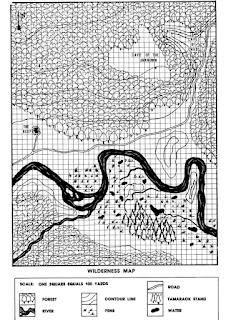
Land crawl

Image
The first mode of adventuring most of us old schoolers learned was the classic dungeon crawl, in which a party of adventurers explored an enclosed, often underground, area. Dungeons were, and are, generally drawn on graph paper at a scale of 10 feet per square, and explored on a time scale of ten-minute turns. Movement is given in feet per turn. Among the strengths of the dungeon crawl are that it provides natural barriers and boundaries to channel exploration, and that pretty much all the interesting features can be explicitly noted, either on the map or in the dungeon key.  The next mode was the wilderness or hex crawl, so named because the map is typically drawn on hex paper with one terrain feature representing each hex. Hex crawls are conducted on a scale of miles -- the exact scale varies, but 6 miles per hex is widely regarded as optimal -- and take place on a time scale of days. Movement is expressed in miles per day. Hex crawls are great for long range overland travel, and...