Posts

Showing posts with the label wilderness

Wilderness and dungeon levels

 Being able to assess the risk of adventure locations is a vitally important aspect of old school play, especially the sandbox style. In dungeons, this is a relatively simple matter: the danger increases as you descend deeper into the dungeon. Dungeon levels are typically numbered, starting with 1 for the first level, typically the most easily accessible, and progression to higher numbers with each level farther from the main entrance. Monsters found on a given level will tend to have the same number of Hit Dice as th e dungeon level (e.g. on the third level of the dungeon, 3 HD monsters are most common) and more loosely, traps and other hazards become more deadly. The amount and value of treasure also tends to increase with dungeon level. There are some twists on this formula; some dungeons may have additional entrances that lead directly to deeper levels, and some dungeons may be "layered" horizontally rather than vertically, but the overall principle is that players will b...
Land crawl

Image
The first mode of adventuring most of us old schoolers learned was the classic dungeon crawl, in which a party of adventurers explored an enclosed, often underground, area. Dungeons were, and are, generally drawn on graph paper at a scale of 10 feet per square, and explored on a time scale of ten-minute turns. Movement is given in feet per turn. Among the strengths of the dungeon crawl are that it provides natural barriers and boundaries to channel exploration, and that pretty much all the interesting features can be explicitly noted, either on the map or in the dungeon key.  The next mode was the wilderness or hex crawl, so named because the map is typically drawn on hex paper with one terrain feature representing each hex. Hex crawls are conducted on a scale of miles -- the exact scale varies, but 6 miles per hex is widely regarded as optimal -- and take place on a time scale of days. Movement is expressed in miles per day. Hex crawls are great for long range overland travel, and...

Magical trees

Every fantasy world needs more than just monsters and dungeons populating its wilderness areas. Magical trees are a great way to add a little color and mystique to a campaign setting, and something for adventuring PCs to interact with and possible use. If you've got a dark and gloomy forest, a haunted graveyard, a mystical mountaintop, or a desert oasis, what better way to give them some extra zing? Magical trees may look like some type of ordinary tree, or may be of unusual color, shape, size, or otherwise distinctive features. Trees have all manner of possible uses, from shelter to materials for constructing things mundane or magical to food and medicine. When some magical effect is mentioned below, and no means of invoking them is mentioned, consider whether fruit or nuts, sap, leaves, blossoms, bark, or wood lends itself best to a particular use, and by what means. Tree of Life : A leaf from the very top of this tree has the power to restore life to a recently deceased creature...

Special wilderness locales

Tired of wilderness encounters with nothing but monsters? Here are some other interesting things a party might stumble across while trekking cross-country. A convenient list of 30 for those who have a d30 on hand. Use them by themselves or combine them with a monster encounter or terrain feature. (I'd recommend not using them all the time; perhaps a 1-in-6 or 1-in-12 chance per day of travel.) 1. Battlefield. The site of some forgotten battle of old, strewn with the rusted remains of arms and armor half-buried in the earth. Possibly haunted. 2. Enchanted tree. Its fruits produce the effects of a random potion at half-strength, but spoil a day after picking. Has 2d6 ripe fruits when found. 3. Faerie ring. Mushrooms growing in a circle. Will a character stepping into their midst be put to sleep by mischievous faeries or whisked away to a mystical forest? 4. Burial cairn. Whose eternal resting place is this?  5. Cache of supplies. A stash of iron rations, rope, torches, oil, or ot...

Where does that wilderness encounter happen?

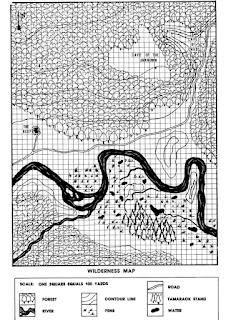
 Wilderness random encounters in classic D&D are a little vague and generic. Determine the local terrain features and add some detail and interest to the scene of an encounter. d8 Clear, Grassland Forest Hills 1 Farmland Hill Hill 2 Copse Gully Ridge 3 Hill Dell Valley 4 Stream Stream Ravine 5 Pond/Lake Pond/Lake Stream 6 Wetland Thicket Gully 7 Pasture Glade Pond/Lake 8 Gully Burn Dell d8 Mountains River Desert 1 Ridge Rapids Dunes 2 Ravine Sandbar Wadi 3 Stream Wetlands ...