Land crawl
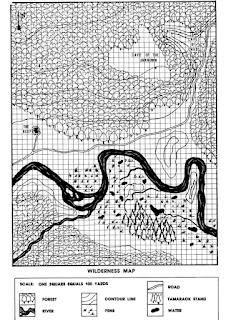
The first mode of adventuring most of us old schoolers learned was the classic dungeon crawl, in which a party of adventurers explored an enclosed, often underground, area. Dungeons were, and are, generally drawn on graph paper at a scale of 10 feet per square, and explored on a time scale of ten-minute turns. Movement is given in feet per turn. Among the strengths of the dungeon crawl are that it provides natural barriers and boundaries to channel exploration, and that pretty much all the interesting features can be explicitly noted, either on the map or in the dungeon key. The next mode was the wilderness or hex crawl, so named because the map is typically drawn on hex paper with one terrain feature representing each hex. Hex crawls are conducted on a scale of miles -- the exact scale varies, but 6 miles per hex is widely regarded as optimal -- and take place on a time scale of days. Movement is expressed in miles per day. Hex crawls are great for long range overland travel, and...